Search This Blog

Showing posts with label square root. Show all posts

Wednesday, March 4, 2015

March 4: Equations with Square Roots

Today we learned how to solve equations by taking the square root.

We started with the equation a2 + 17 = 20


Even though the variable has an exponent, we're going to pretend it doesn't.

So how would solve the simpler equation a + 17 = 20?  We'd start by isolating the variable.

Remember 2-Step Equations from AAALLLLLLLLL the way back in September?  That's exactly what this problem is, so that's exactly how we're going to solve it!


When we subtract 17 from both sides, we eliminate the constant on the left so that the term with the variable is the only thing on that side of the equal sign.

Now we know that

a2 =4

Sooooooo, what number, when multiplied by itself, will equal 4?

If you're not sure, take the square root of each side to determine the answer!

 a = 2

Lastly, we need to substitute our answer in for the variable in the original problem to confirm our work.  Does a2 + 17 = 20 when a = 2?


Yes, it works!  So we know that a = 2 is the correct answer.

Tuesday, March 3, 2015

March 3: Estimating Square Roots

Unit 6 Tests were returned today, so if you did not do as well as you would have liked, make sure you make your test corrections TONIGHT.  If your score was less than 70%, you are required to complete test corrections!


Today we talked about Estimating Square Roots.  In order to estimate the value of a square root of a number that is not a perfect square, it helps to first KNOW the prefect squares.


 1=
1

 22=
4

 32=
9

 42=
16

 52=
25

 62   =

36

 7=

49

 82=

64

 92=

81

102=
100

112=
121

122=

144


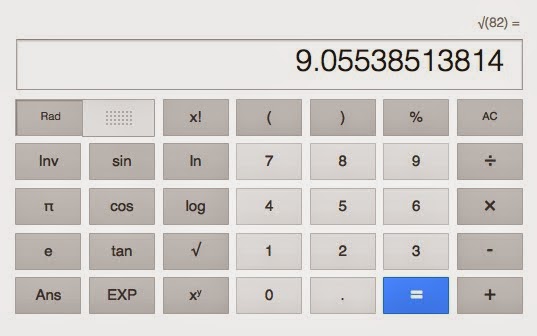
So if we are given the value 82, we can easily see the value will be between the integers 9 and 10, because the square root of 81 is 9, and the square root of 100 is 10.  And since 82 is much closer to 81 than it is to 100, we can also determine that the value of 82 is much closer to 9 than it is to 10.  To confirm this, we can check on a calculator.


And we can see that the square root of 82 is about 9.06, which is of course much closer to 9 than 10.


And be sure to study your perfect square and perfect cube flashcards that were passed out today.  We will be taking a quiz on those on FRIDAY, MARCH 6.

Monday, March 2, 2015

March 2: Square Roots

Happy Monday!  Today we started Unit 7: Square Roots and Pythagorean Theorem.

Today's lesson was an introduction to SQUARE ROOTS.  It's actually easier to start with SQUARES, and then talk about square roots.

To square a number, we just multiply it by itself.

For example, 5 squared = 5 × 5 = 25

When we take a number and multiply it by itself, we call the product a PERFECT SQUARE.

5 × 5 = 25

25 is a perfect square, because 5 × 5 = 25.  We can also say that 5 squared is 25.

Square roots go the other way: since 5 squared is 25, the SQUARE ROOT of 25 is 5.


A square root of a number is ...
... a value that can be multiplied by itself to give the original number.
 
A square root of 9 is ...
... 3, because when 3 is multiplied by itself we get 9.
It is like asking:
What can we multiply by itself to get this?


The first 12 squares:
1 Squared =  12 =   1 × 1 = 1
2 Squared =  22 =   2 × 2 = 4
3 Squared =  32 =   3 × 3 = 9
4 Squared =  42 =   4 × 4 = 16
5 Squared =  52 =   5 × 5 = 25
6 Squared =  62 =   6 × 6    =  36
 7 Squared= 72=7 ×7=49
 8 Squared= 82=8 ×8=64
 9 Squared= 92=9 × 9=81
10 Squared=102=10 ×10=100
11 Squared=112=11 ×11=121
12 Squared=122=12 ×12=144

Click here for today's homework